
Spilt Milk 2025 is Sold Out: A Triumphant Return Fueling Australia’s Live Music Renaissance
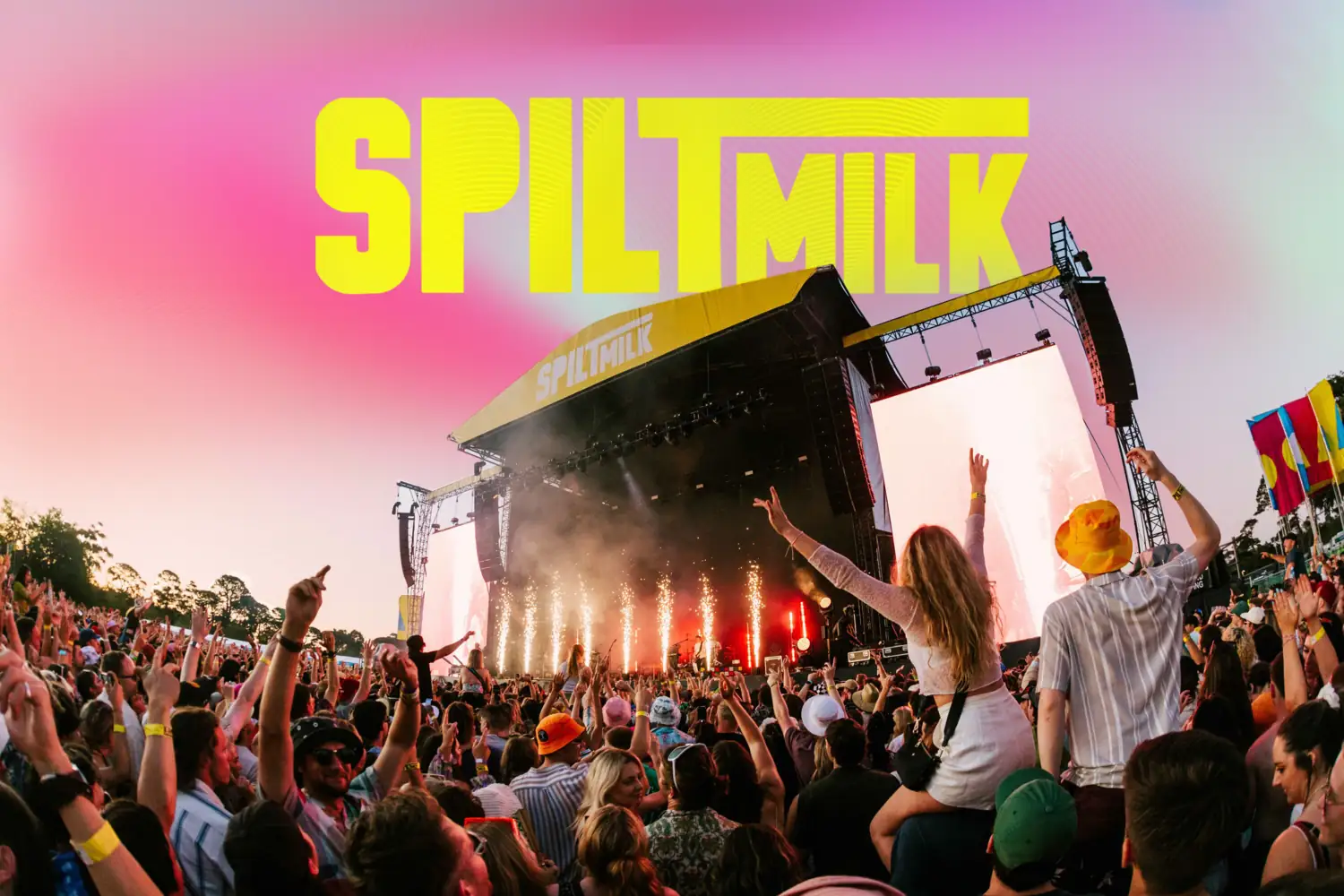
Spilt Milk is sold out, officially and totally. I jumped into the pre-sale queue just before 11am, and by the time I reached checkout at 11:23am for the Gold Coast show, tickets had already surged to the fourth release tier. At $270 AUD each for myself, my partner, and a friend, it wasn’t cheap—but considering the stellar lineup, I figured it’d be well worth it.
Reflecting on Spilt Milk’s lightning-fast sell-out and my unforgettable experience at this year’s Laneway Festival, it feels like we’re witnessing what many fans are calling a festival renaissance. After years of pandemic cancellations, weather disruptions, and the disappointing loss of major festivals in 2024, Spilt Milk’s hugely successful return feels like a game-changer. Selling out across Canberra, Ballarat, the Gold Coast, and Perth, this single-day, multi-city event proves that Australia’s live music scene isn’t just recovering—it’s thriving.
The festival’s rapid sell-outs, superstar lineup, and innovative production have positioned it at the forefront of a new wave of Australian music festivals, alongside events like Laneway Festival, which are redefining the live events landscape. Industry experts and fans alike are buzzing that Spilt Milk 2025’s achievement “is precisely what the live music scene needed,” signaling a revival of energy and optimism in Australia’s live music and event production sector.
Join our newsletter
Stay up to date on the live event industry, event management tips aswell as CrowdFlo news
We prioritise your data's security in our terms
A New Era for Australian Music Festivals
In this in-depth report, we’ll explore how Spilt Milk 2025 became a standout success – from its dates and locations to its star-studded lineup and record-breaking ticket sales. We’ll also examine fan reactions, the hype around headliner Kendrick Lamar’s Australian return, and the festival’s widely praised curation and branding. Furthermore, we’ll compare Spilt Milk’s meteoric rise with the recent struggles of legacy festivals like Splendour in the Grass (which faced cancellations in consecutive years), highlighting how fresh, multi-genre festivals like Spilt Milk and Laneway are leading a new era. Finally, we’ll discuss what this means for the future of live music and events nationwide – an era many are dubbing a live event renaissance – after a rocky few years of cancellations.
Whether you’re an event professional, venue manager, or music industry executive, the story of Spilt Milk 2025 offers a deeper insight into Australian music festivals’ evolving landscape – and a glimpse into a brighter future for festival production, ticketing, and fan engagement in Australia.
Spilt Milk 2025 Overview: Dates, Locations and Growth of a Touring Juggernaut
Spilt Milk Festival’s 2025 edition marked its largest geographic reach to date, spanning four locations over two weekends. The festival kicked off at Ballarat (Wadawurrung Country) on Saturday 6 December 2025, then headed west for a debut in Perth (Whadjuk) on Sunday 7 December, returned the following weekend to its “spiritual home” of Canberra (Ngunnawal) on Saturday 13 December, and wrapped up on the Gold Coast (Kombumerri) on Sunday 14 December. This ambitious routing effectively turned Spilt Milk into a national touring festival, bringing the party to multiple states and both coasts of Australia. It’s a remarkable growth from the festival’s origins – Spilt Milk began as a single-day event in Canberra in 2016 and, over the past decade, has steadily expanded its footprint.
Each location’s event in 2025 was a one-day festival featuring the same lineup of artists, a model similar to other successful Australian touring festivals like Groovin the Moo and Laneway. By covering multiple major cities and regions, Spilt Milk not only tapped into a broader audience base but also spread economic benefits across communities. For instance, the Canberra leg – held at Exhibition Park in Canberra (EPIC) – is supported by the ACT Government’s Major Event Fund, recognising the festival’s contribution to the local economy and tourism. As a flagship event in the ACT, Spilt Milk boosts Canberra’s appeal as a youth destination and injects significant spending into local businesses. The same can be said for Ballarat, Gold Coast, and now Perth, where thousands of attendees traveled, booked accommodation, and patronised local establishments thanks to the festival.
Spilt Milk’s multi-city approach also illustrates a key trend in event production: scalability and flexibility. Rather than staging one enormous festival in a single location (with all the financial risk that entails), the organisers – Kicks Entertainment – have developed a roadshow model that can be replicated in various cities. Production infrastructure (stages, sound, lighting, and set designs) and artist logistics are coordinated across the tour, achieving economies of scale while maintaining a consistent experience. Attendees in each city got the same top-tier production and lineup, complete with the festival’s signature touches like vibrant art installations, diverse food offerings, and carnival-like atmospherics. Spilt Milk has become known for its immersive festival experience, and 2025 was no exception – from stunning stage visuals to interactive sponsor activations, the festival delivered a cohesive vibe that traveled with it.
Crucially, 2025’s edition is a comeback story for Spilt Milk. The festival took a hiatus in 2024, skipping that year despite a hugely successful 2023 showing. Organisers announced the 2024 cancellation with a characteristically tongue-in-cheek statement: “Sorry pookies, we couldn’t get you the Spilt Milk you deserve this year… imma dip for a bit and come back when I can make all ur dreams come true. i miss u xx SPILT MILK”. True to their word, they returned in 2025 with an even bigger outing – probably one of the strongest lineups in recent Australian music history. The 2025 return was formally announced in early May, immediately generating excitement across the industry and fan community. As one outlet described, “Spilt Milk… is officially back for 2025, with dates now locked for four massive cities across the country this December”. The stage was set for a banner year, and Spilt Milk delivered on that promise.
Why Spilt Milk is Sold Out? A Star-Studded Lineup with a Multi-Genre Mix Led by Kendrick Lamar
One of the biggest factors in Spilt Milk 2025’s success was its blockbuster lineup, which drew widespread praise for both star power and diversity. At the very top of the bill was none other than Kendrick Lamar, one of the most influential figures in modern hip-hop. Booking Kendrick as a headliner was a major coup that had music fans buzzing. As Pedestrian TV gushed, “At the very tippity-top of the line-up is rap god Kendrick Lamar… After the spectacular year Kendrick’s had, this is a pretty impeccable get.” Indeed, Kendrick’s 2025 has been spectacular by any measure: the Compton rapper picked up a string of Grammy Awards earlier in the year and delivered one of the most memorable Super Bowl halftime performances in recent memory. Spilt Milk 2025 marked Kendrick Lamar’s first Australian festival dates in eight years and his first shows in Australia since December 2022, making his appearance a huge draw for fans who hadn’t seen him since his last tour. The anticipation for his set was sky-high – not only would attendees get to witness a Pulitzer Prize-winning artist with a deep catalog of hits, but they also hoped for surprises (Pedestrian joked about fingers crossed for a SZA cameo, referencing Kendrick’s famous collaborations). Kendrick did not disappoint, bringing an explosive live show to each Spilt Milk city, treating Australian fans to a world-class performance that many had feared they might not see on home soil again.
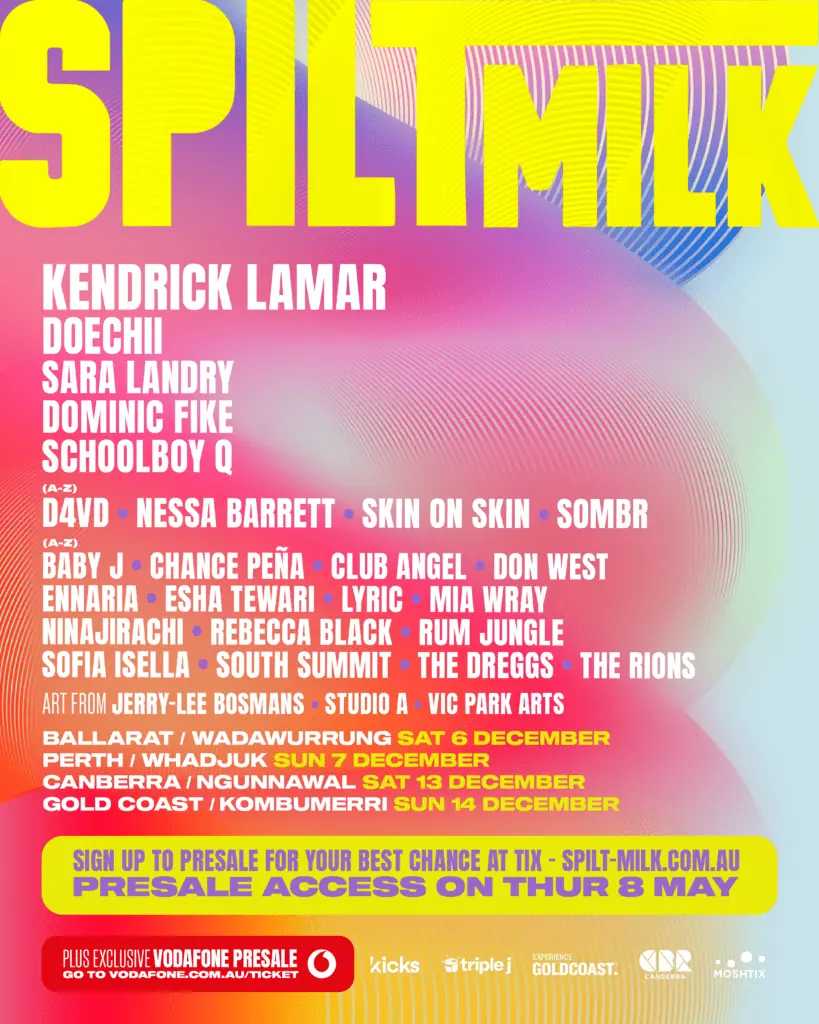
Joining Kendrick as a co-headliner is Doechii, a rapidly rising star in the rap world. Hailing from Tampa, Florida, Doechii has had a breakout 2024-2025: she released her acclaimed mixtape Alligator Bites Never Heal in late 2024, scored a #1 hit in Australia with the Gotye-sampling single “Anxiety,” and then made history at the 2025 Grammy Awards by becoming only the third woman to ever win Best Rap Album. In other words, Doechii’s stardome has risen to unbelievable heights over the past two years. Spilt Milk 2025 will be Doechii’s first-ever trip to Australia, and she arrived with significant hype as a Grammy-winning rapper and a performer known for high-energy, genre-blending shows. Media outlets billed her as “arguably [rap’s] fastest-rising star” and a perfect complement to Kendrick on the lineup. Doechii’s inclusion signaled Spilt Milk’s commitment to cutting-edge hip-hop as well as strong female representation. Her sets – featuring hits like “Anxiety” and other tracks that showcase her rapid-fire flow and R&B sensibilities – were among the festival highlights, proving why she’s considered an “iconic queen” by fans and why 2024 and 2025 have seen Doechii’s star rise to new heights.
The lineup’s star power didn’t end with those two. ScHoolboy Q, a fellow member of Kendrick’s for label TDE (Top Dawg Entertainment) and an influential West Coast rapper in his own right, was on the bill, bringing some extra 2010s hip-hop cred to the festival. Dominic Fike also featured prominently – the American singer-songwriter and guitarist who not only has a devoted indie/alt fanbase for his genre-blending music, but also fame from his acting role in HBO’s Euphoria. Fike’s inclusion added an alternative/indie-pop flavor to Spilt Milk, and he drew a big crowd of indie kids eager to hear hits like “3 Nights” and “Babydoll” live.
On the electronic music front, Spilt Milk 2025 secured Sara Landry, a fast-rising techno DJ/producer known for her heavy industrial-tinged sets. Sara Landry’s presence, alongside Aussie electronic sensation Skin on Skin (whose underground techno/trance fusion has a cult following), meant the festival had plenty to offer for electronic music fans seeking a dance-floor frenzy. In fact, Time Out noted that the lineup also featured “US heavyweight DJ Hekate” – an apparent reference to an electronic act on the roster – underscoring that Spilt Milk wasn’t just about hip-hop and pop, but also catered to the techno/rave crowd.
Pop and viral internet culture got a nod with Rebecca Black on the lineup – yes, the same Rebecca Black who became a meme with “Friday” a decade and a half ago, (yes, you’re that old) but who has since reinvented herself as a hyperpop/alt-pop artist & DJ. Rebecca Black has a notable following for her new music, and her booking by Spilt Milk shows the festival’s finger is on the pulse of online trends and nostalgia acts turned legit performers. Meanwhile, Gen Z pop was further represented by Nessa Barrett, an American social media star-turned-singer known for her emo-pop tracks and huge TikTok following. The presence of Barrett and Black meant the festival tapped into the younger demographic of pop fans and internet culture enthusiasts.
Crucially, Spilt Milk 2025 also championed Australian talent across its lineup. Homegrown artists in the mix included indie-rock outfits The Rions and Rum Jungle, soulful singer-songwriter Mia Wray, indie-folk duo The Dreggs, electronic producer Ninajirachi, alt-pop singer Sofia Isella, DJ Baby J, and more. These local artists are some of the cream of the Aussie crop, Rolling Stone noted that Mia Wray and Ninajirachi were featured in their “Future of Music 2025” list. By giving them slots alongside international headliners, Spilt Milk is reinforcing its reputation for stellar curation – blending big international names with the best of emerging and established Aussie acts. This balance of genres and artists is exactly what earned the festival media praise as a “genre-blurring juggernaut… known for its stellar lineups” that “continues to cement its place as one of the premier live music events on the Australian calendar.”
Fans and critics widely applauded the 2025 lineup for its breadth. Pedestrian.tv declared “the Spilt Milk 2025 line-up is significantly better than expected”. Time Out Australia called the lineup “absolutely insane,” highlighting the wide mix of West Coast hip-hop legend Kendrick Lamar, rap powerhouse Doechii… plus Dominic Fike, ScHoolboy Q, D4VD, Nessa Barrett, Skin on Skin and Sombr,” noting there were acts for all tastes. For me, Kendrick alone could’ve sold the ticket – the sheer breadth of the rest of the lineup was just an icing on the case that meant the $810 total I spent on GA level tickets didn’t sting quite as much.
In short, Spilt Milk 2025’s artist roster struck a chord with a broad audience – from rap fans and pop lovers to EDM ravers and indie aficionados – showcasing the power of a carefully curated, multi-genre festival lineup in drawing huge interest.
Record-Breaking Ticket Sales: Spilt Milk’s Sold-Out Shows and Unprecedented Demand
With such a strong lineup and the buzz of a comeback, it’s no surprise that tickets for Spilt Milk 2025 were some of the hottest of the year. What did surprise even the organisers was the extent of the demand. When tickets went on sale in May 2025, all three east coast dates – Ballarat, Canberra, and Gold Coast – sold out within hours of the general on-sale, making it “the biggest on sale in Spilt Milk’s history” according to Rolling Stone. This means 2025 set a new record for the festival in terms of number of tickets sold and the speed at which they were snapped up. In fact, festival reps confirmed that 2025 sold the most tickets ever for a Spilt Milk edition. The only city with any tickets left by day’s end was Perth, which as a newer market for Spilt Milk had a few remaining (and those are expected to go very soon – perhaps by the time this blog is published)
The ticket buying process for 2025 was notable as well. Anticipating massive demand (and likely hoping to thwart scalpers and bots), Spilt Milk implemented a ticket request and pre-registration system through Moshtix. Starting May 2, fans could lodge a ticket request by pre-authorising payment – essentially entering a ballot to “lock in” tickets if selected – before the general public sale. This innovative approach gave genuine fans a fair chance and helped manage the typical website crashes and frantic rush that accompany big festival sales. On May 8, a presale (including a sponsor/Vodafone presale) opened, and on May 9 the remaining General Admission tickets were released in timed waves for each city. They staggered ticket sale times by location (8AM AEST for Canberra, 9AM for Ballarat, 10AM AEST for Perth which was 8AM local, and 11AM for Gold Coast). This staggering was designed to let dedicated fans potentially buy tickets to multiple cities if they were willing to try sequentially – and indeed some superfans did attempt to attend more than one Spilt Milk stop.
Despite these measures, demand outstripped supply almost instantly. Thousands of fans took to social media to express excitement if they scored tickets – or despair if they missed out. The phrase “Spilt Milk sold out” trended on Twitter (X) in Australia that morning, and the festival’s official pages urged unlucky fans to join official waitlists (rather than buy from scalpers). Ticket prices didn’t deter buyers at all: those who got in early via the Moshtix ballot paid a flat $219.95 + fees per ticket, while the general sale tickets were priced in tiered “release” waves ranging from $194.95 up to $259.95 (+$10 fees) for the final release. In other words, even at roughly $270 AUD a ticket for the last release – a price firmly at the higher end for a one-day festival – Spilt Milk had no trouble selling out. Myself & other fans just see it as good value given the caliber of the lineup (Kendrick Lamar’s solo arena tour tickets often cost as much or more), and the convenience of a full festival experience in one day.
The secondary market lit up immediately after the sell-out. Resale platforms like Viagogo showed Spilt Milk tickets being listed at significant mark-ups, despite organisers’ warnings against scalping. (Some tickets appeared on resale sites for double their face value within a day of selling out, illustrating the pent-up demand.)
Industry observers marveled at the result: in a climate where just a year prior some festivals couldn’t sell enough tickets to go ahead, here was Spilt Milk “confirming that the December stops in Ballarat, Canberra and Gold Coast have already sold out” just hours after release. The speed of sales and sheer number of attendees (tens of thousands per city) underscored that Australian music fans are eager to return to festivals when the offering is right. As Rolling Stone put it, “The response for the returning Spilt Milk festival has been even bigger than expected”, and 2025’s turnout proved that point.
For context, each Spilt Milk city can host roughly 20,000–30,000 attendees (the exact capacity varies by venue). Canberra’s EPIC and Gold Coast Sports Precinct can accommodate around 25,000; Ballarat’s Victoria Park similar; Perth’s Claremont Showground potentially a bit more. If all four events sold out or came close, that’s on the order of 100,000+ total attendees across the tour. These are huge numbers for a festival brand only in its 6th edition. It’s a sign that Spilt Milk has built a loyal following and a strong reputation. The festival’s track record of selling out in previous years was already solid, but 2025’s instant sell-outs, especially after a year off, point to an almost fervent level of anticipation.
Fans on forums and Reddit noted how Spilt Milk’s successful comeback gave hope for other festivals. One commenter on the r/triplej discussion forum mused that if Spilt Milk can pull off such a strong return after a hiatus, perhaps struggling festivals like Groovin the Moo or Splendour “can do the same in the future” – indicating that Spilt Milk 2025 became a bit of a beacon of hope for Australia’s festival lovers. Social media was also filled with praise for the organisers’ savvy lineup choices and the relatively smooth ticketing process (a few gripes about queue systems aside). By all accounts, the demand demonstrated in 2025 confirms that live music events in Australia are not only back, but back in high demand.
Fan Reactions and Festival Experience: Hype, Social Buzz, and Brand Praise
In the months and weeks leading up to the festival, fan excitement for Spilt Milk 2025 was through the roof. The lineup reveal in May ignited a flood of reactions on social platforms. TikTok and Instagram were rife with lineup breakdowns and hype videos – one viral TikTok sound proclaimed, “Australia’s most in-demand festival just dropped its biggest lineup yet,” highlighting how special it was to have Kendrick Lamar and Doechii on the bill. Fans on Twitter celebrated the diversity of the lineup, with tweets like “Kendrick and Doechii on the same festival? Take my money!” and “Spilt Milk really said we’ll give you a bit of everything – I’ve got FOMO already.” The hashtag #SpiltMilk2025 trended when tickets sold out, as those who missed out lamented their fate or begged friends for spares.
All of this positive reception feeds a larger narrative: Spilt Milk has solidified itself as one of Australia’s most beloved and important festivals. It’s no longer the new kid on the block; it’s a trendsetter that’s drawing praise from fans and industry alike for its branding, booking, and execution. In a year where the live music scene desperately needed a win, Spilt Milk 2025 provided a blueprint for how to do festivals right, showing that if you know your audience and deliver quality, the enthusiasm is undeniably there.
Spilt Milk vs. the Old Guard: The Rise of New Festivals and the Decline of Legacy Events
The meteoric rise of Spilt Milk (and its contemporaries) comes in stark contrast to the recent struggles of legacy Australian festivals – most notably, Splendour in the Grass. Splendour, once the country’s premier winter music festival, has had a rough few years. In 2022, it was plagued by severe weather and muddy conditions that turned into a bit of a PR nightmare; in 2023, it returned but under the cloud of past issues; and then, in 2024, Splendour in the Grass was abruptly cancelled just a week after tickets went on sale, citing “unexpected events”. That cancellation (for what would have been a July 2024 event) shocked the industry – Splendour had been held annually since 2001 and typically drew around 50,000 attendees to Byron Bay. The 2024 lineup was to feature major acts like Kylie Minogue, Arcade Fire, and Futuree=, yet poor ticket sales and controversy (Arcade Fire’s frontman faced misconduct allegations, which hurt reception) led organisers to pull the plug. It was the second year in a row Splendour was cancelled (they also took 2023 off, it appears), and the organisers admitted they needed “a little more time to recharge” the festival.
Industry analysis later revealed the deeper issues: Splendour’s ticket sales were far below expectations, and skyrocketing production costs made it unfeasible to proceed. The head of the Australian Festival Association, Mitch Wilson, explained that costs for festivals had risen 30-40% across the board (due to inflation, supply chain issues, and a weak Australian dollar), while big international artists have many options elsewhere making it hard for Aussie fests to compete. In Splendour’s case, the festival simply could not sell enough tickets at the price needed to cover costs. Organisers and promoters were left questioning whether the era of the mega-festival was waning.
Splendour wasn’t alone. Another staple, the Falls Festival, also canceled its 2024 edition (and as of early 2025 had not announced a return). Falls, which had been a New Year’s multi-day festival across multiple states, struggled post-Covid and also faced venue challenges and community resistance. Similarly, the regional traveling festival Groovin the Moo scrapped its 2024 tour due to insufficient ticket sales and announced it would not run in 2025 either. Groovin had been a beloved regional festival since 2005, but even it couldn’t escape the downturn, with organisers saying they’d use the break to find a “more sustainable model” for the future. Other events like Harvest Rock (a newer festival in Adelaide) and the long-running Caloundra Music Festival also canceled 2024 plans. By early 2025, more than 10 Australian music festivals had been canceled in the previous year – a situation that had many live music professionals worried about a full-blown crisis for festivals.
It’s in this context that Spilt Milk’s success is especially noteworthy. Unlike Splendour and Falls, which are owned by global live entertainment giant Live Nation, Spilt Milk is an independent festival (produced by the Australian company Kicks Entertainment). Some observers have drawn a comparison: Live Nation’s festivals seemed to falter in 2024 (Splendour, Falls, and Harvest Rock – all Live Nation/Secret Sounds events – were cancelled), whereas independent festivals like Spilt Milk and the boutique Laneway Festival managed to thrive in 2025. The Guardian pointed out that Spilt Milk was part of a “wave of beleaguered live music festivals that cancelled their 2024 events, including Splendour in the Grass, the Falls festival and Harvest Rock… as well as Groovin the Moo”, yet Spilt Milk’s 2025 comeback was a “strong comeback” that defied the trend. In other words, amidst an industry shake-up where some older festivals appear to be in decline or needing to regroup, Spilt Milk emerged as a bright spot signaling that festivals can succeed if done differently.
So what is Spilt Milk doing differently? For one, scale and timing. Spilt Milk is a one-day event (in each city) rather than a multi-day camping festival. This lowers the barrier to attendance (fans don’t need to commit to a whole weekend or spend on camping/accommodation if they’re local) and also reduces some logistical overhead. It’s easier to evacuate or manage a one-day crowd in bad weather, for example, versus the chaos Splendour faced with campers stuck in mud for days. Additionally, Spilt Milk’s timing in early summer (December) might be more favorable – after the school/university exam season, when young people are ready to celebrate, and with generally reliable weather. Splendour takes place in winter (July) when weather on the Byron Bay site can be volatile, as 2022 proved. Timing and format give Spilt Milk an agility that some legacy fests lack.
Another key difference is musical positioning and brand image. Splendour historically leans towards rock, indie, and some electronic/hip-hop, but its 2024 lineup (Kylie Minogue, for example) was a pivot that perhaps didn’t resonate with its core audience. Spilt Milk, on the other hand, has cultivated a brand of being hip, youth-oriented, and trend-aware. Its curation skews toward what’s hot with the under-30 crowd: chart-topping rap, viral pop, cutting-edge EDM, etc. Spilt Milk’s ability to land Kendrick Lamar – a bona fide, S+ tier artist in rap – for a regional touring festival stunned many (in a good way), whereas Splendour’s choice of Arcade Fire (an aging indie rock band mired in controversy) was met with a shrug or even backlash. The lesson: know your audience and program accordingly. As Rolling Stone noted in their coverage, Spilt Milk 2025’s lineup was stellar and directly fed the high demand that resulted; conversely, Splendour’s lineup failed to ignite enough interest to overcome other headwinds.
Finally, pricing and value perception differ. Splendour and Falls tickets are quite expensive (hundreds of dollars for multi-day passes) and come with added costs (camping gear, travel to remote sites, etc.), which might be harder for audiences to justify in tight economic times. Spilt Milk’s roughly $200 one-day tickets, while not cheap, were perceived as fair for the convenience and the star lineup delivered. Moreover, Spilt Milk’s sell-out success itself becomes a virtuous cycle – the event gains a can’t-miss reputation, so people scramble to buy tickets early next time. Splendour, after a cancellation and a muddy fiasco in prior years, has unfortunately lost some trust and prestige among fans (some commenters openly wondered if Splendour has lost its magic for good). Meanwhile, Spilt Milk’s buzz is more akin to the early days of Splendour or Big Day Out – an exciting, new-generation festival that people are desperate to attend.
All told, the rise of Spilt Milk relative to the troubles of older festivals illustrates a changing of the guard in Australia’s festival scene. The big takeaway for event professionals is that innovation, curation, and understanding the modern festival-goer are key. Legacy alone is not enough – Splendour’s long history didn’t save it from cancellations. But fresh approaches, like Spilt Milk’s, are pointing the way forward.
A New Wave of Festivals Leading a Live Event Renaissance
Spilt Milk isn’t the only success story hinting at a broader live event renaissance in Australia. St Jerome’s Laneway Festival – another multi-city, multi-genre festival – made a roaring comeback in early 2025 after a hiatus, and its success parallels Spilt Milk’s in many ways. Laneway 2025 spanned cities in Australia and New Zealand (Brisbane, Sydney, Melbourne, Adelaide, Perth, plus Auckland) in February 2025 and, according to organisers, it was the biggest edition of Laneway ever, drawing over 200,000 fans to sold-out shows across all cities. Headliners included Charli XCX, indie pop darlings Clairo and Beabadoobee, UK electronic duo Bicep, and local heroes like Skegss. The festival not only sold out its main events but also saw 40,000 additional tickets sold to sideshows (solo headline shows by festival acts in other cities) – indicating extraordinary demand. Off the back of this, Laneway’s co-founders confidently announced the festival would return again in 2026, and they thanked fans for making 2025 “our new North Star” of what Laneway can be.
Crucially, Rolling Stone Australia declared Laneway’s triumphant return “precisely what the live music scene needed“, capturing the relief and excitement that live music was not just recovering, but thriving. The quote could just as easily apply to Spilt Milk’s success at the end of 2025. After the turmoil of cancellations and the doldrums of the pandemic years, these wins have injected fresh hope into the industry. It feels like Australian music festivals have turned a corner – learning from the challenges of recent years and emerging with new strategies that work in today’s climate.
What defines this new wave of festivals? A few common threads stand out:
- Multi-Genre, Curated Lineups: Festivals like Spilt Milk and Laneway are not pigeonholed into one style. They blend genres to appeal to the broad tastes of modern audiences who might shuffle from hip-hop to punk to EDM in their playlists. Gen Z is more diverse in their listening than any other generation – by far… This multi-genre approach not only casts a wider net for ticket buyers, but it also creates a unique festival identity. Laneway has long been known for breaking indie acts and mixing cutting-edge pop; Spilt Milk is now known for blending mainstream big names with alternative and dance acts. This curatorial approach contrasts with older festivals that might rely on legacy rock bands or a single-genre focus.
- Touring Festival Model: Both Spilt Milk and Laneway take the festival to the fans, rather than asking all fans to come to one remote location. This touring model (multiple cities) can increase overall attendance (as seen by Laneway’s 200k total fans across cities) and bring live music to more corners of the country. It’s a trend that could grow – we may see more festivals opting to do mini-tours instead of one-offs, especially in a country as geographically spread out as Australia. The success of these tours suggests that with good planning, the model is operationally feasible and financially rewarding.
- Youthful Branding and Engagement: The new wave festivals have a brand voice and image that resonates with younger attendees (teens to 30s). Their marketing is social media-savvy, often humorous or creatively cryptic (for instance, Spilt Milk teased its lineup with hints on TikTok leading up to the drop). They engage fans directly – via Instagram Q&As, interactive AR filters, etc. – building community year-round, not just at the event. This fosters loyalty and word-of-mouth buzz that you can’t buy with traditional ads alone. Crowds at Spilt Milk and Laneway skew younger than those at legacy fests, which is a positive sign for longevity: hook the new generation early and you can potentially have them as repeat customers for years.
- Focus on Experience (Beyond Music): While music is the core, these festivals emphasise the overall experience – food, art, comfort, safety. Spilt Milk, for example, incorporates local art installations and “Instagrammable” spots, diverse food trucks (often promoting local vendors or trendy cuisines), and even elements like carnival rides or lounges. Laneway similarly is known for its cool urban locations and street food markets. By making the festival a holistic experience, they increase the perceived value of the ticket and differentiate themselves. This is increasingly important as festivals compete with not just each other but also with other forms of entertainment for consumers’ dollars.
- Adaptability and Innovation: Perhaps most importantly, the new wave is willing to adapt. Whether it’s new ticketing methods (like Spilt Milk’s Moshtix pre-reg system) or adjusting to feedback (Laneway had an all-ages issue in Auckland and quickly reorganised to comply with licensing, showing flexibility in operations), these events are proving to be nimble. They also seem more open to embracing technology – from cashless payments to festival apps that give set times and updates, enhancing the attendee experience in practical ways.
The broader commentary from industry experts is that we are witnessing a rebirth of the Australian live events scene after a very challenging period. The successful execution of Spilt Milk 2025 and Laneway 2025, plus other positives like the return of niche festivals (e.g. heavy music’s Good Things Festival also reported strong attendance in late 2024), suggest that pent-up demand for live entertainment is being unlocked. Fans are buying tickets in droves when the event checks the right boxes. This bodes well for 2026 and beyond: perhaps we’ll see some festivals that bowed out reimagining themselves and coming back, or entirely new festivals launching to fill voids. Indeed, Live Nation (Splendour’s parent company) indicated in a statement that while Splendour is on pause, they are “working on exciting new projects to support artists and the industry” to meet fan demand in other ways. That could mean new festival concepts or one-off events emerging.
In sum, the festival renaissance in Australia is characterised by innovation, audience-first thinking, and genre-diverse programming. It’s a response to lessons learned – both from the pandemic (never take live music for granted) and from market realities (fans want quality and won’t settle for subpar experiences). Spilt Milk 2025, by breaking ticket records and thrilling fans, has become a case study in how to thrive in this environment. As we move forward, the hope is that this renaissance continues to build momentum, creating a sustainable ecosystem where artists, promoters, and audiences all benefit.
The Road Ahead: Implications for Event Professionals and the Role of Platforms like Crowdflo
The success of Spilt Milk 2025 holds several important lessons for event professionals, venue managers, and promoters. First and foremost, it demonstrates that demand for live music in Australia is back – possibly even stronger than before – but capturing that demand requires the right formula of programming, pricing, and promotion. Major music brands and promoters (from independents to giants like Live Nation and Secret Sounds) will be analysing Spilt Milk’s approach to inform their own strategies. Here are a few implications and takeaways:
- Curation is King: Investing in a standout lineup and understanding the current musical landscape is crucial. Spilt Milk’s team clearly identified which artists would create buzz (e.g., securing a hip-hop legend amid a relative dearth of big rap tours in Australia created unique value). Event organisers should similarly aim to curate lineups or event programs that are timely and tailored to their target audience’s tastes. This might mean taking calculated risks on rising stars (as Spilt Milk did with Doechii, and Laneway often does with breaking indie acts) and ensuring diversity to broaden appeal.
- Audience Engagement and Branding: Building a strong brand around an event can pay dividends in loyalty and free publicity. Spilt Milk has a distinct brand voice and vibe that people want to be part of. Organisers should think beyond just booking acts – how can the event’s branding, social media presence, and on-site experience form a coherent identity that fans latch onto? The more an event can stand for something (youthful fun, cultural inclusivity, whatever it may be), the more it can cultivate a community that sticks with it. This extends to how bad news is handled – note how Spilt Milk’s candid, quirky message about cancelling 2024 (“i miss u xx”) kept fans on-side, whereas more corporate-sounding statements might not have.
- Operational Excellence and Safety: High-profile festival failures (from Fyre Festival internationally to local incidents) have made audiences and regulators justifiably concerned about safety and organisation. The renaissance will only continue if events maintain strong safety records and positive attendee experiences. That means crowd management, weather contingency plans, sound quality, amenities, and all the behind-the-scenes work need to be executed at a professional standard. Event producers should invest in experienced safety officers, use data (e.g. crowd flow simulations), and not cut corners on essentials like medical services or security. Spilt Milk 2025’s smooth execution enhances trust – attendees will come back next year knowing it’s a well-run show. Conversely, any serious mishap can set the whole scene back.
- Flexibility in Ticketing and Pricing: As seen with Splendour and Groovin’s issues, pricing events correctly in this economy is tricky. Spilt Milk’s tiered pricing and innovative pre-sale registration likely maximised conversion of interested fans. Organisers might consider similar “demand-based ticketing” models or early bird incentives to gauge interest and secure revenue early. Additionally, fighting scalping and fraud is vital for maintaining fan goodwill. Technology that allows easy transfer of tickets (for genuine fans reselling at face value) but prevents mass scalping (like dynamically generated QR codes or capped transfer systems) can help. Fans appreciate when organisers actively combat scalpers and keep pricing fair on the primary market.
This is where event technology platforms become crucial allies for organisers. Modern festivals are complex operations that require integrated solutions – ticketing, marketing, access control, data analytics, and more. Crowdflo, for example, is a rising “event-in-a-box” platform that aligns well with the needs illuminated by this new festival era. With Crowdflo, organisers can manage ticket sales, attendee communications, and on-site entry systems in one place, benefiting from features specifically designed for today’s challenges. Let’s look at how a platform like Crowdflo can support the kind of success Spilt Milk achieved:
- Competitive Pricing & Low Fees: One frequent complaint from festival-goers is high ticketing fees from big vendors. Crowdflo addresses this by offering low fees and competitive pricing for organisers, which can be passed on as savings to attendees or used to preserve the event’s margins. In an environment where every dollar counts (remember those slim margins Splendour faced due to costs), saving on ticketing fees can be significant. A platform that doesn’t gouge organisers or fans builds trust and makes it more viable to price tickets accessibly – thus encouraging sales.
- Advanced Ticketing Security: Crowdflo provides robust security measures like remote pass access revocation. For instance, if a ticket is reported lost or if fraud is detected (say an malicious reseller tries to sell the same QR code to multiple people), the organiser can invalidate that pass remotely, instantly. This kind of control is a boon during festivals where thousands of tickets are in circulation; it helps clamp down on counterfeit tickets and keeps crowd counts accurate.
- Live Customer Support: Festivals happen in real-time, and issues will inevitably arise (a ticket not scanning, a patron with an incorrect registration, etc.). Crowdflo distinguishes itself with live customer support, meaning event staff or even attendees can get immediate help troubleshooting ticketing or access issues. Rather than leaving festival staff stranded with a generic support email, Crowdflo’s team is accessible to quickly resolve problems – an invaluable feature when you have a gate about to open and need a solution now. This level of support is something often lacking with bigger, impersonal ticketing companies, and it can make a huge difference in keeping operations smooth and customers happy.
- Holistic Event Management (“Event in a Box”): Crowdflo’s ambition to be an “event in a box” means it’s not just ticketing software; it’s aiming to be a one-stop platform where organisers can do everything from setting up an event page, handling online promotions/invitations, monitoring ticket sales in real-time, communicating updates to ticket holders, and even managing on-site check-ins with scanning apps or devices. By simplifying the tech stack needed to run an event, platforms like Crowdflo lower the barrier for organisers to execute events efficiently. For example, a mid-sized promoter could use Crowdflo to replicate some of the sophisticated techniques Spilt Milk used – like phased ticket releases, waitlist management, and targeted comms – without needing a huge IT team. Democratising event tech will lead to more events being launched and run successfully.
- Data and Insights: In the current era, data is key. Crowdflo can provide organizers with rich data on ticket buyer demographics, sales trends, peak entry times, etc. Event managers make more informed decisions when armed with these insights (e.g., perhaps data shows an increasing number of attendees coming from a state that isn’t currently served by the festival – a hint to expand there, much like Spilt Milk did by adding Perth). Data also helps in tailoring marketing – knowing your audience profile helps attract sponsors and craft better lineups. While not a public-facing feature, this analytic capability is a backbone for continuous improvement in festival planning.
By highlighting these features and the general mission of platforms like Crowdflo, it’s clear that technology and innovation in event management will underpin the next phase of growth in Australia’s live events. Just as festivals are innovating in their format and content, the backend infrastructure (from ticketing software to logistics systems) must innovate to support them. Crowdflo is part of that movement – working to simplify and secure the many moving parts of event organisation.
For major players in the industry – be it a company like Live Nation or an independent promoter – partnering with agile tech platforms and adopting best practices will be crucial. The renaissance we’re seeing is an opportunity, but also a challenge: high fan expectations mean events must deliver excellence consistently. With tools like Crowdflo, organisers have a better shot at meeting those expectations without prohibitive costs or complexity.
Spilt Milk 2025 and the Future of Live Events in Australia
I genuinely think that Spilt Milk Festival 2025 will be remembered as a landmark event in the story of Australia’s live music revival. Its sold-out shows, blockbuster lineup, and seamless production proved that large-scale festivals can not only survive the turbulent post-pandemic period – they can come back stronger and even outshine their past. In doing so, Spilt Milk and its peers (like Laneway) have charted a path forward for the industry: one that embraces change, prioritises the fan experience, and leverages new tools and ideas to overcome challenges that sank others.
For event professionals, the success of Spilt Milk 2025 is both inspirational and instructive. It underscores the importance of knowing your audience and delivering value, the power of savvy marketing and branding, and the non-negotiable need for operational competence. It also highlights the role of modern event platforms in enabling that success – with robust ticketing, support, and data capabilities now available to even modest-sized events, the technical hurdles are lower than ever for those willing to innovate.
In the end, the comeback of festivals like Spilt Milk isn’t just about music—it’s about bringing people together again. It’s mates arm-in-arm belting lyrics, strangers dancing until sunset, and those moments you talk about long after the last act leaves the stage. Spilt Milk 2025 reminded everyone why festivals matter: they’re the heartbeat of youth culture, community, and pure, unfiltered fun. And as events like these keep stepping up their game—with help from platforms like Crowdflo making them easier and more affordable to organise—Australia’s festival scene feels more alive than ever. The milk’s been spilt, and honestly, we’re here for it. Well, I’ll definitely be here for it—every minute of it—because at $270 a ticket, you better believe I’m squeezing out every drop. Yet somehow, I already know it’ll be worth every cent.
- By
- Nic Coulter
The opinions expressed in the article are from the perspective of the individual, not AAC, Crowdflo or it’s subsidiaries.
Share this post